
How Revenue-Focused SEO Turns Search Visibility Into Customers and Revenue
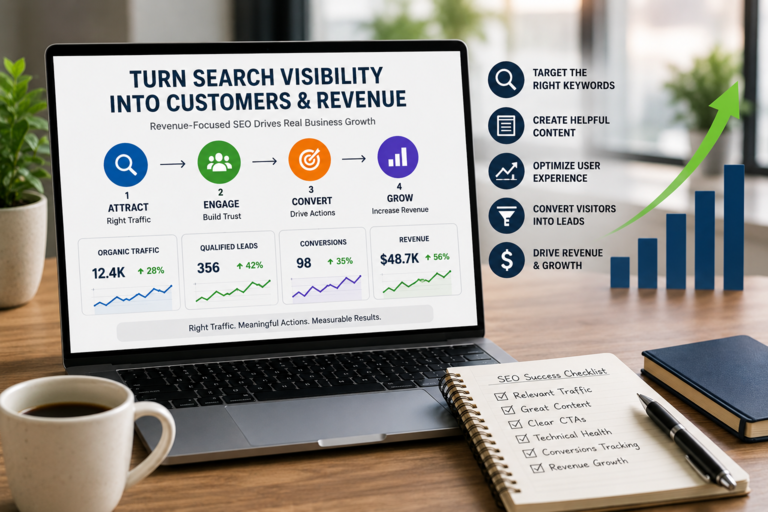
Getting your website to appear in search results is useful, but visibility alone does not grow a business. The real opportunity comes when search traffic leads people toward meaningful actions, such as contacting your team, requesting information, booking a service, or making a purchase.
Revenue-Focused SEO connects search visibility with customer behavior and business revenue. Instead of treating rankings, impressions, and traffic as the final goals, it focuses on attracting the right audience, answering their questions, building trust, and guiding visitors toward becoming customers.
For businesses, this means creating content and optimizing pages around real customer needs and commercial goals. Attimi Agency can use this approach to help businesses look beyond search rankings and understand how organic search can contribute to qualified leads, conversions, and long-term growth.
The goal is simple: bring more relevant visitors to the website, provide a useful experience, and give those visitors a clear reason to take the next step.
In the sections below, we will explore how revenue-focused SEO works, why search visibility alone is not enough, how content and technical optimization influence conversions, and which metrics can help connect SEO performance with actual business growth.
What Is Revenue-Focused SEO?
Revenue-Focused SEO is an approach that connects search engine optimization with measurable business results. It considers the complete journey from a person's search query to the action they take after arriving on a website.
Traditional SEO often focuses heavily on rankings, keywords, backlinks, and traffic. These factors still matter, but they do not always tell you whether the website is attracting potential customers.
A revenue-focused approach asks more useful questions about performance.
Are the right people finding the website?
Are visitors reaching pages that match their needs?
Are important landing pages generating inquiries?
Are organic visitors becoming customers?
Which search topics are connected to business growth?
This changes SEO from a traffic exercise into a business growth strategy.
Why Search Visibility Alone Is Not Enough
Ranking highly can bring more people to a website, but more visitors do not automatically mean more customers. A page can receive thousands of visits and still produce very few meaningful actions if it does not match search intent.
The strongest SEO strategies connect visibility with relevance. When someone searches for a solution, the page they find should provide a clear and useful answer.
That creates a better path from search to conversion.
Visibility gets attention: Search results introduce your business to potential customers.
Relevance builds interest: Useful content gives visitors a reason to stay.
Trust supports decisions: Clear information makes the business feel more credible.
Conversion creates opportunity: Strong calls to action encourage the next step.
Revenue measures impact: Customer activity shows whether SEO is helping the business grow.
The important shift is to stop asking only, "How much traffic did we get?" and start asking, "What did that traffic contribute to?"
How Revenue-Focused SEO Connects Search To Customers
A successful search strategy follows the customer journey rather than focusing on isolated keywords. Different searches often represent different levels of awareness and buying intent.
Someone searching for a general question may still be learning. Another person may already be comparing providers or looking for a specific service. Both searches can be valuable, but they require different types of content. A revenue-focused strategy creates useful experiences for each stage.
Understanding Search Intent
Search intent helps explain what a person actually wants when they enter a query into a search engine. Informational searches usually involve questions or research. Commercial searches often involve comparing solutions. Transactional searches show stronger intent to take action. Matching content to these needs makes organic traffic more useful.
Creating Content Around Real Problems
Content should answer questions that potential customers genuinely care about. It should also make the next step obvious without forcing a sales message into every paragraph. Helpful content can build familiarity before a visitor is ready to buy.
Improving Conversion Paths
A visitor should not have to search around the website to figure out what to do next. Relevant internal links, clear calls to action, easy navigation, and useful service information can make the journey much smoother.
Turning Organic Traffic Into Qualified Leads
Once relevant visitors reach a website, the next challenge is helping them become qualified leads. This requires more than simply adding a contact button to every page. Each page should have a clear purpose and a logical next step.
For example, an educational article can guide readers toward a related service page. A service page can answer common concerns and make contacting the business easy. A product or solution page can provide the information needed to support a purchase decision.
The goal is to reduce uncertainty.
Use clear calls to action: Tell visitors what they can do next.
Answer objections: Address common concerns before they become barriers.
Build useful internal links: Help visitors move naturally between related pages.
Improve landing pages: Make important pages focused, relevant, and easy to understand.
Track meaningful actions: Monitor leads, inquiries, bookings, and other valuable conversions.
This is where seo services in New Jersey can become more valuable when they are planned around actual customer journeys instead of rankings alone.
The Technical Side Of Revenue Growth
Technical SEO supports revenue by making websites easier for search engines to crawl and easier for visitors to use. A technically strong website gives important pages a better foundation for visibility and engagement.
Technical improvements should support business priorities. Fixing every technical issue is not automatically the best use of resources. The focus should be on problems that can affect visibility, user experience, conversions, or important customer journeys.
Core areas can include website structure, page performance, mobile usability, indexing, redirects, broken links, structured data, and crawlability.
Technical seo optimizations can be especially useful when important commercial pages are difficult for search engines to understand or visitors struggle to use them.
The best technical work is practical. It should help search engines discover valuable content while making the website easier for real people to navigate.
Using Content To Capture High-Value Searches
Content plays an important role because customers rarely search using only one type of query. Their questions change as they move closer to a decision. A strong content strategy covers different needs without creating repetitive pages.
Educational articles can attract people early in the journey. Comparison content can help people evaluate options. Service pages can capture stronger purchase intent. Supporting content can answer questions that prevent visitors from converting.
This creates a connected search ecosystem.
Educational content: Helps people understand a problem.
Commercial content: Helps people evaluate possible solutions.
Service content: Explains what the business provides.
Conversion content: Gives visitors a clear path to take action.
Supporting content: Answers questions that influence decisions.
Businesses working on digital marketing in New Jersey can benefit from connecting content strategy with local customer needs, industry questions, and commercial search intent.
Measuring What Actually Matters
Revenue-focused SEO needs meaningful measurement. Rankings can change, and traffic can rise or fall, but the larger question is whether organic search is creating useful business outcomes.
A measurement framework should connect search activity with actions that matter to the business. Important metrics may include organic conversions, qualified leads, conversion rates, revenue attributed to organic search, landing page performance, and engagement with high-intent pages.
It is also useful to look at which pages and search topics contribute to conversions rather than treating all traffic as equal. For example, 100 visitors who are actively looking for a solution may be more valuable than 1,000 visitors who have no intention of becoming customers. The quality of traffic matters as much as the quantity.
How SEO Can Support Long-Term Business Growth
SEO is rarely a one-step activity. Search behavior changes, competitors publish new content, customer expectations evolve, and search engines continue to improve how they understand information. A revenue-focused strategy therefore needs regular evaluation.
Businesses should identify which pages are performing well, which topics are attracting qualified visitors, and where potential customers are leaving the journey. These insights can guide future content and optimization work.
You can also explore how different search strategies work together in our guide on GEO vs. SEO vs. AEO and which strategy will dominate search in 2026.
This broader view helps businesses adapt without losing sight of their main objective: generating meaningful business results from search.
Common Mistakes That Limit SEO Revenue
Even a website with strong rankings can struggle to generate customers when the strategy is focused on the wrong goals. Several common mistakes can create a gap between visibility and revenue.
Understanding these problems makes it easier to build a stronger approach.
Chasing traffic alone: Large traffic numbers do not guarantee qualified prospects.
Targeting irrelevant keywords: Ranking for searches unrelated to your services rarely creates useful business opportunities.
Ignoring conversion paths: Visitors need clear and simple ways to take action.
Publishing without purpose: Content should support a customer need or business objective.
Neglecting existing pages: Updating valuable pages can be as important as creating new ones.
Failing to measure leads: Without conversion data, it is difficult to understand business impact.
The solution is not always more content. Often, it is better alignment between search demand, website experience, and customer intent.
A Simple Revenue-Focused SEO Process
Building a revenue-focused strategy does not have to be complicated. The process can start with understanding the business and then connecting search opportunities to customer needs.
A practical workflow can include the following steps.
1. Identify Business Goals: Start by defining what SEO needs to support, such as qualified leads, sales, bookings, or inquiries.
2. Understand Your Best Customers: Identify the questions, problems, concerns, and search behaviors associated with your ideal customers.
3. Find Valuable Search Opportunities: Prioritize search topics based on relevance, intent, business value, and the likelihood that they can attract potential customers.
4. Optimize Important Pages: Improve service pages, landing pages, product pages, and other important areas of the website so they answer customer needs clearly.
5. Build Supporting Content: Create useful content that answers related questions and connects naturally to commercial pages.
6. Track Conversions: Measure actions that indicate real business interest, not just impressions and clicks.
7. Improve Based On Results: Use performance data to identify what is working, what needs improvement, and where new opportunities exist.
This process turns SEO into an ongoing system rather than a one-time campaign.
Turn Search Visibility Into Business Growth
Search visibility is valuable, but it becomes far more powerful when it connects to real customer actions. Revenue-Focused SEO brings together search intent, useful content, technical performance, conversion paths, and meaningful measurement to create a stronger connection between organic search and business growth.
Instead of celebrating traffic alone, businesses can focus on attracting the right audience and helping those visitors become customers. Attimi Agency can take this revenue-centered view of SEO to create strategies that are aligned with measurable business goals.
If your website is attracting visitors but not enough qualified opportunities, it may be time to rethink what your search strategy is designed to achieve. Contact Us to explore how a clearer connection between search visibility, customer intent, and conversions can support your next stage of growth. The goal is not simply to be found. The goal is to be found by the right people and give them a clear reason to choose your business.